
Level 1 vs Level 2 EV Charging: What the Difference Means in Practice
Shopping for home charging, you will quickly run into "Level 1" and "Level 2". They sound technical, but the difference is simple and it shapes the whole experience of owning an EV. Here is what each one means once the car is actually in the driveway.
Level 1: The Cable in the Boot
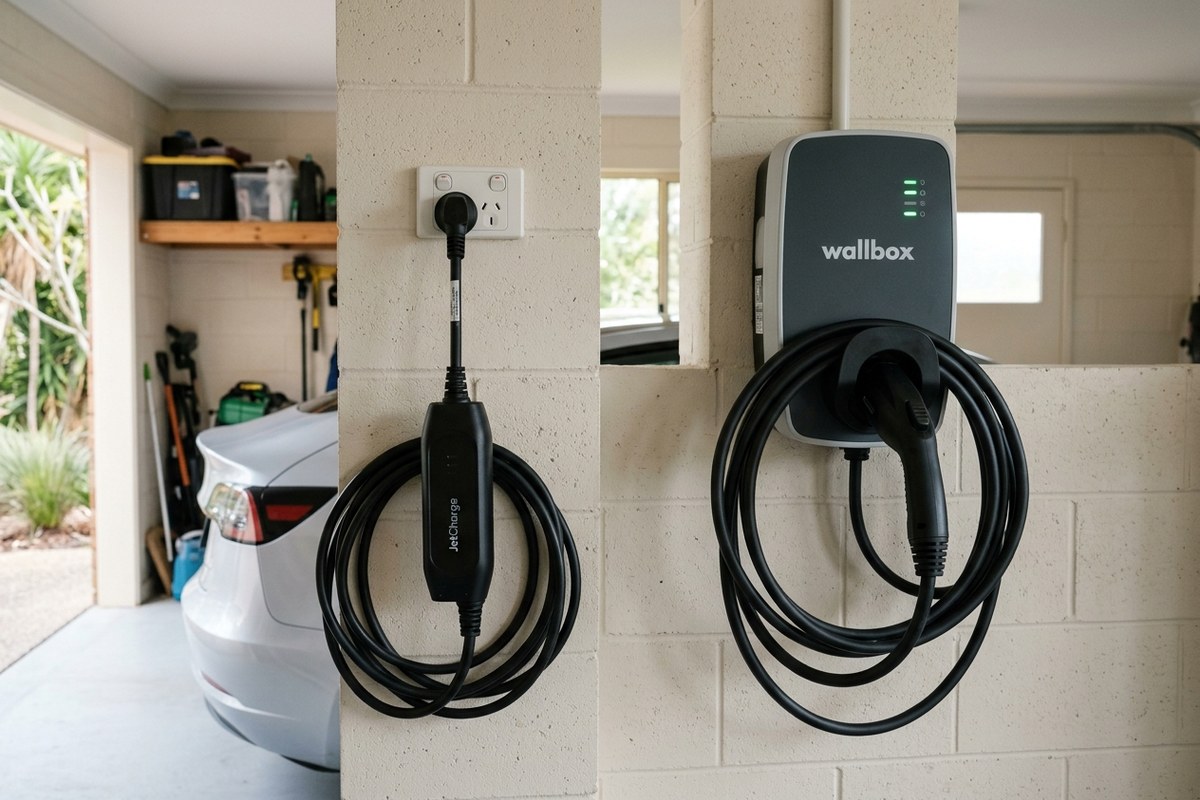
Level 1 is the portable cable that comes with most EVs, plugged into an ordinary 10-amp power point. It needs no installation, which is its one real advantage. The trade-off is speed: it adds only around 10 to 15 kilometres of range an hour. It also draws a steady load through a general-purpose circuit and power point that were not designed for hours of continuous high current, which is fine occasionally but not ideal as a daily habit.
Level 2: The Dedicated Wall Charger
Level 2 is a wall-mounted charger on its own dedicated circuit, installed by a licensed electrician. It delivers several times the power, a common 7kW unit adds roughly 40 to 50 kilometres of range an hour, and runs on a circuit built for the job, with its own protection. This is what makes home charging genuinely effortless: plug in at night, full by morning, every time.
The Practical Difference
For someone who drives very little and can leave the car plugged in for long stretches, Level 1 can scrape by. For nearly everyone else, Level 2 is the difference between charging being a background non-event and being something you have to plan around. The faster top-up also means the car spends less time tied up charging and more time simply ready.
Safety and the Long Game
Beyond speed, a Level 2 install puts charging on a dedicated, properly protected circuit rather than leaning on a household power point for hours at a time. For a car that will be charged most nights for years, that dedicated setup is the sounder long-term arrangement, and it is why every EV maker recommends a proper home charger.
What About DC Fast Charging?
You may also hear about "Level 3" or DC fast charging, the high-power chargers at public stations that can add hundreds of kilometres in under an hour. These are not a home option: they require industrial-scale power and equipment far beyond a residential supply. Home charging is AC (Level 1 or 2); DC fast charging belongs to the public network for long-trip top-ups. So for a home, the real choice is only ever Level 1 versus Level 2.
Matching the Level to Your Driving
For a household that drives normal daily distances and parks at home overnight, Level 2 is the obvious fit, it turns charging into something you never think about. Level 1 only really suits a second car that barely moves, or a stopgap while a proper charger is organised. If the car is your daily driver, the small cost of a Level 2 install pays itself back in convenience every single morning.
For a Central Coast household weighing the two, the deciding factor is rarely the hardware cost, it's how charging fits daily life. Level 2 makes the car a genuine set-and-forget appliance; Level 1 keeps charging as a chore you have to manage. For anyone driving most days, that difference is felt every morning, which is why a dedicated Level 2 install is the default recommendation for a daily driver.
There is also a safety dimension worth restating. A Level 2 charger sits on its own circuit with its own protection, sized for the job, whereas Level 1 borrows a general power point for hours at a time. For a one-off top-up that is fine, but as a nightly routine the dedicated circuit is simply the sounder arrangement, which is the underlying reason vehicle makers and electricians alike steer regular drivers toward a proper Level 2 install rather than relying on the cable in the boot.
Frequently Asked Questions
Can I just use the cable that came with my car?
You can, as a backup or for very light driving. It is slow at around 10 to 15 kilometres of range per hour and leans on a general power point for hours, so it is not ideal as a daily setup. A Level 2 charger is far better suited to regular use.
How much faster is Level 2?
Several times faster. A 7kW Level 2 charger adds roughly 40 to 50 kilometres of range per hour versus the 10 to 15 of a wall socket, so it comfortably refills a day's driving overnight.
Does Level 2 need an electrician?
Yes. It is a dedicated circuit connected to the switchboard with its own protection, so it must be installed and certified by a licensed electrician.
Is Level 1 unsafe?
Used occasionally it is fine, but charging for hours every day through a general-purpose power point is not what that circuit was designed for. A dedicated Level 2 circuit is the safer arrangement for regular charging.
Ready to Move Up to a Proper Home Charger?
Get a free, no-obligation quote from a licensed electrician serving the Central Coast.