
Tesla Wall Connector vs the Mobile Connector: Home Charging Options Compared
Tesla owners have two obvious ways to charge at home, and they get mixed up constantly. One is the Mobile Connector that may have come with the car; the other is the Wall Connector, a fixed home charger. They are not the same thing, and the difference is worth understanding before assuming the cable in the boot is enough.
The Mobile Connector
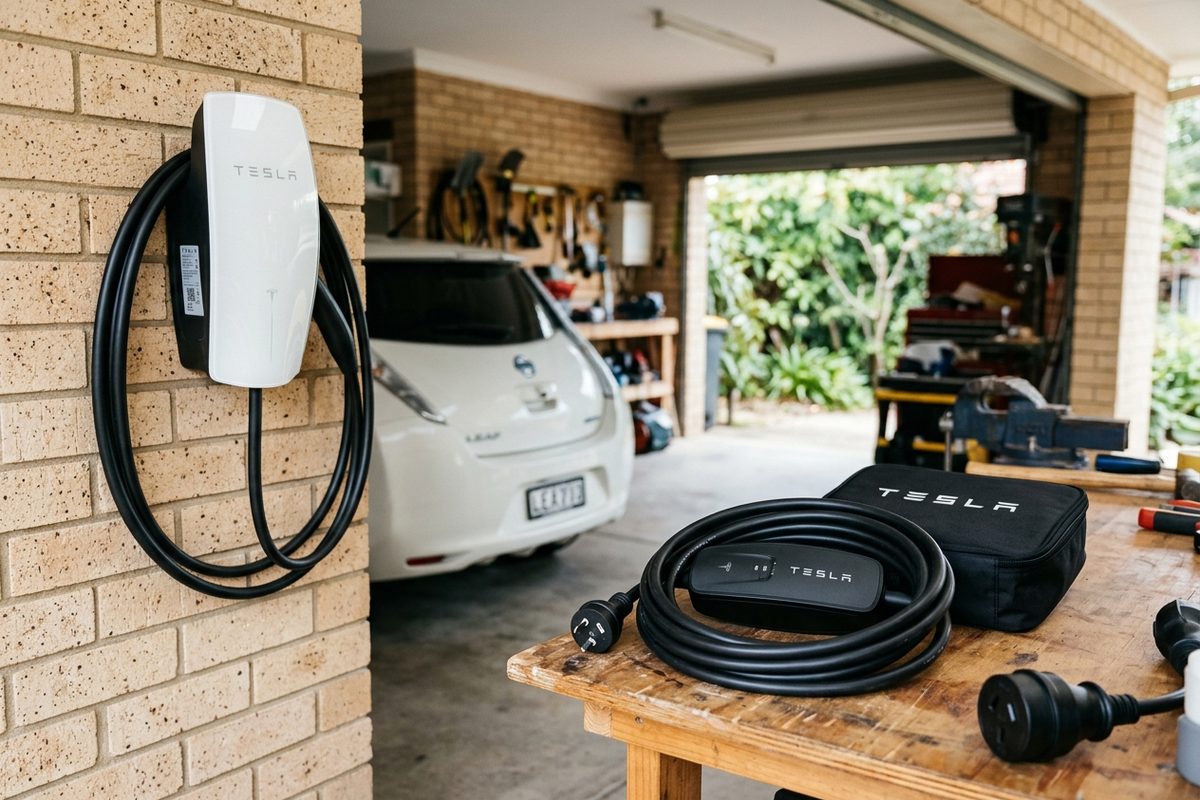
The Mobile Connector is a portable cable kit. Plugged into an ordinary household power point, it charges slowly, fine as a backup or for very light driving, but it leans on a general-purpose circuit for hours and adds only a small amount of range per hour. It's convenient for travel and topping up away from home, not really built to be a daily home solution.
The Wall Connector
The Wall Connector is a permanently installed home charger, hardwired to its own dedicated circuit by a licensed electrician. It charges several times faster than the Mobile Connector on a normal power point, runs on a circuit built for the sustained load, and is the setup Tesla intends for home use. It's also tidy, fixed to the wall with the cable on a holster, ready every night.
Speed in Practice
On a single-phase Central Coast home, a Wall Connector delivers around 7kW, comfortably refilling a day's driving overnight. The Mobile Connector on a standard outlet manages a fraction of that. For anyone driving regularly, the Wall Connector turns charging into a non-event; the Mobile Connector can struggle to keep up.
Cost and the Honest Trade-Off
The Mobile Connector's appeal is that it's already there, with no installation. The Wall Connector costs more up front because it's a unit plus a proper install, but it buys speed, safety on a dedicated circuit, and daily convenience. For a household charging at home most nights, that's usually money well spent; for someone who rarely needs to charge at home, the Mobile Connector might do.
Which to Choose
The deciding question is how the car is used. Daily driver, parked at home overnight, charging regularly: the Wall Connector. Occasional home charging with most topping up done elsewhere: the Mobile Connector may suffice. Either way, anything hardwired must be installed by a licensed electrician on its own circuit.
Can You Use Both?
Many owners do exactly that. The Wall Connector handles daily charging at home, fast, fixed, effortless, while the Mobile Connector lives in the boot as a backup for travel, a relative's house, or anywhere with a power point and no dedicated charger. They complement each other: one is the daily workhorse, the other is the just-in-case. Buying a Wall Connector doesn't make the Mobile Connector redundant; it just moves it to backup duty.
Getting the Wall Connector Set Up Right
Because the Wall Connector is hardwired, the install matters as much as the unit. A licensed electrician confirms the switchboard can carry it, runs the dedicated circuit, mounts the unit where the cable reaches the car easily, and commissions it to the home's safe maximum rate. Where two Teslas share a driveway, units can be linked to share power so the home isn't overloaded, worth flagging at the quote if a second car is on the cards.
For a Central Coast Tesla owner charging at home most nights, the Wall Connector is almost always the right call, with the Mobile Connector kept as a travel backup. The only real exception is the rare driver who tops up mostly elsewhere and barely charges at home. As with any hardwired install, the value comes from doing it properly, a dedicated circuit, a sensible mount, and commissioning to the home's safe rate.
It is also worth thinking a step ahead. If a second EV might join the household, the Wall Connector's ability to link units and share power makes that far simpler to accommodate later, where relying on Mobile Connectors and power points would not. Raising the possibility at the quote stage lets the circuit and mounting be planned with a little room to grow, so adding a second charger down the track is a small job rather than a rebuild.
Frequently Asked Questions
Isn't the Mobile Connector enough for home charging?
For light or occasional use, possibly. But it charges slowly on a normal power point and leans on a general circuit for hours, so for regular daily charging the Wall Connector is faster, safer on its own circuit, and far more convenient.
How much faster is the Wall Connector?
Several times faster. On a single-phase home it delivers around 7kW and refills a day's driving overnight, where the Mobile Connector on a standard outlet manages only a fraction of that per hour.
Does the Wall Connector need professional installation?
Yes. It's hardwired to a dedicated circuit and must be installed and certified by a licensed electrician. The Mobile Connector just plugs into an existing power point.
Can a Wall Connector charge non-Tesla EVs?
Yes. It uses the Type 2 standard, so it charges any compatible EV, not just Teslas, though the app features are oriented to Tesla owners.
Setting Up a Tesla at Home?
Get a free, no-obligation quote from a licensed electrician serving the Central Coast.